Friday, November 23, 2012


Picture Day Friday


Ye Olde Fleece Inn is located at 14 Highgate in Kendal, Cumbria. Established in 1654 as a flourishing posting inn, it still boasts a thriving business. Food served is typical British fare, including Hanky Panky Pie (!!), and dozens of ales. Normal modern full-bar range of drinks are also served.


Image is copyrighted by Adam Bruderer.

Monday, November 19, 2012


Lord Byron was a fan, too!


When we idolize our favorite authors, we tend to forget that they, in turn, idolize other authors.

The first time this was brought home to me was when I attended my first annual conference of the Romance Writers of America in Dallas in 2007. As I squealed and babbled over my role models and beloved writers that I met in the hallways, in elevators, and of course, in the bar (best place to hang out at RWA!), I saw them also greet other authors with likewise delighted squeals.

I suddenly realized, that yeah, they're human, too, and readers first, authors second. They, too, love books just like I do and treasure their best-remembered reading experiences just like I do. Suddenly, these New York Times bestseller authors didn't seem so out in the stratosphere for the lowly aspiring author in me.

So it came as no surprise to me, when I came across this article in the UK Huffington Post that talks about a copy of Frankenstein that belonged to Lord Bryon and features an inscription by Mary Shelley has been discovered. Byron was a Shelley fan. I get just how he felt. (Click on the link to see a photograph of the inscription.)

Monday, November 12, 2012


High Tea: Pinky Up or Down


High Tea, as a tradition, has humble beginnings. It was traditionally served at around five in the evening at farms all around Britain's countryside. At the end of a long day that began before dawn, farmers and farm workers returned home tired and hungry. Along with cups of strong tea, served with milk and sugar, platters of hearty sandwiches (with meat, cheese, and veggies) and pastries (such as scones, tea cakes, jam rolls, etc.) were also served. An informal meal, it was consumed at the kitchen table, which originally had high stools in lieu of chairs for seating, hence the name "High Tea." This was the main meal of the evening followed up a light supper at eight o'clock.

Image copyrighted by Love Bites http://www.flickr.com/photos/58139202@N07As urbanization became more and more the norm, the rituals around high tea also shifted. It became more of a stylish and less hearty meal, more of a fancy tea, and was consumed between three and four o'lock in the afternoon. The dining room with a neatly laid out service—of fine bone china, exquisite linen napkins, crystal stemware, and real silver eating utensils—became de rigueur. Delicate finger food was served with a variety of lightly-brewed teas. Sandwiches and pastries still featured highly on the menu, but the smaller size of the offerings allowed for tiered serving dishes and lace doilies.

Modern High Tea is very popular in the UK as well as in Canada, the United States, New Zealand, and Australia.
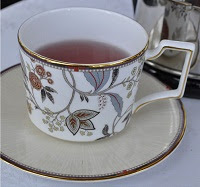
Image copyrighted by Love Bites http://www.flickr.com/photos/58139202@N07 Tea is served with warm milk, sugar, lemon, and honey. Hot water is brought to the table in a ceramic jug along with decorative tins of various tea leaves. First, the teapot is rinsed out with hot water to warm the pot. Tea is spooned in, one for each cup of tea plus one for the pot. Appropriate quantity of hot water is poured in and the teapot's covered with a decorative, quilted tea cozy. The tea's allowed to steep for 5–7 minutes, after which it is carefully strained into each cup.

Sandwiches have to be cut into neat triangles and the crust removed. Typical fillings, include cream cheese and lox, cucumber and butter, pâté, smoked trout and horseradish, roast beef with mustard and watercress, crab paste with brandy, etc. Mayonnaise and sliced cheese are supposed to be a big no-no.

Scones are served with "fillings" in small bowls, such as fresh clotted cream, lemon curd, jams, and fruit preserves.

Savory pastries, such as mushroom and chevre tarts, florentine quiches, sausage rolls, cheddar bites, etc. are also served.

Image copyrighted by Love Bites http://www.flickr.com/photos/58139202@N07 The meal's rounded out with sweet pastries, such as jam tarts, mince pies, pecan tartlets, fruit flan, madeleines, raspberry linzers, cheesecakes, lemon bars, shortbread biscuits, custard kisses, sponge cakes, frosted fairy cakes, etc.
Monday, November 5, 2012


Home Offices


Office supplies and home offices are my two favorite hobbies after buying and reading books by the pound. I'm trying to curb my book and supplies buying addictions, but conversely, indulging my home office gawking since it's free.

The Internet is a great resource as are magazines. On the few occasions that I have sat down to design my own office, I've discovered that I'm never as creative as these people with the purchasing and/or the placement of furniture, furnishings, and extras. That is why I love perusing other people's creativity.

Expansive home offices by HGTV are HERE and Decoist's creative offices for small spaces are HERE. Which ones are your favorites of them all? (Please note: all images are copyrighted to either HGTV or Decoist.)

This is my top favorite. I find I like a lot of light in my home office: large windows and lamps plus light woods for furniture (not ceramic, metal, or any other non-wood materials), light-colored walls (not necessarily only beige or oatmeal, but light yellows, too) and high ceilings. What this does is that the rows of books on the walls of bookshelves provide the color in the room and pull attention to them.

Compact home office images copyrighted by Decoist.com

This gets my Most Creative vote:

Compact home office images copyrighted by Decoist.com

Monday, October 22, 2012


New Sub-Genre of Romance


I recently came across a new sub-genre of romance: New Adult. In my quest for an in-depth definition of this new sub-genre, I came across this blog from September 16, 2012 by NA Alley.

The basic definition of New Adult is that it starts when Young Adult ends and ends when Adult starts. By this I mean, for a contemporary fiction novel, the age range for the protagonists is 19–25. There are plenty of people who would say that 19 is really YA and not NA, and in our modern times of the 2010s, the upper range for NA should include the very young 30 also.

The definition gets tricky where historical fiction is concerned. Take Regency-set romances: heroines typically are 17 or 18 on the lower end and by historical society standards, they're adults, not young unattached independent adults (i.e., NA) but full-fledged adults. So would these books come under NA or A? Well, according to NA Alley, it depends on the emotional maturity of the characters.

For heat level in a NA romance, expect the same levels as elsewhere in romance, namely, sweet, sensual, spicy, and erotic.

I hasten to add that contemporary NA is not chick-lit, or rather, it doesn't have to be chick-lit. It can involve all sorts of human life situations and events, just so long as the emotional maturity level and ages of the protagonists remains at the early adulthood level.

For author promotion efforts, NA Alley recommends that writers seek college bookstores and newspapers and NA-friendly social networks.

The NA category is so new that it's not a classification that's widely known even within the publishing industry. So you cannot walk up to a Barnes & Noble employee and ask where they have these books shelved. They're most likely going to be shelved with the adult books.

Note: As of today, Harlequin's Carina Press is open for submissions in the New Adult category.

Monday, October 15, 2012


Missing Pieces in the History of the World


Who and what events and discoveries would you include if you were compiling a History of the World? The BBC came up with their list of most oft overlooked moments. Here are a few:

1. "In 1909, Fritz Haber and Carl Bosch created a way of producing huge amounts of" industrial-grade ammonia for use in fertilizers.

2. "Ibn al-Haytham was born in about 965 in what is now Iraq, and is regarded by some by some as the real father of the scientific method, predating Francis Bacon and Rene Descartes in the 17th Century. He was [also] the first to disprove the theory that we see objects by rays of light emitted from our eyes, realising instead that we see because light enters our eyes."

3. The Danube Script found on Neolithic artefacts is as yet undesciphered and archeologists have not been able to decide whether it is indeed one of the earliest forms of writing or just random, ritualistic symbols.

4. "Double-entry book-keeping, which [was] introduced to Europe in the early 16th Century by the monk Luca Pacioli, is a financial accounting system that [recognizes that] all transactions have two aspects, a credit and a debit, and the two sets of figures [must] always balance."

5. The Seven Years' War (1756-1763) was truly the first World War, since it "involved all the great powers of Europe and saw France, Austria, Russia and Sweden on one side, and Britain, Prussia and Hanover on the other."

6. The Kingdom of Aksum (Axum) in north-eastern Africa became one of the world's greateast markets in the first century CE. It was one of Rome's great trading partners and was characterized by a "highly innovative urban civilisation."

7. The Law Code of King Hammurabi (1792-1750 BCE), the first ruler of the Babylonian Empire, are written in Akkadian, include concepts such as evidence-based justice and giving testimony under oath. Hammurabi "adorns the wall of the American Supreme Court."

8. Angkor Wat of 9th–12th century Cambodia was the "largest pre-industrial urban complex in the world" of its time, with "sophisticated hydraulic engineering and water management systems."