Friday, July 26, 2013


Picture Day Friday: Meenakshi Temple of Madurai India


How gorgeous is that?! Such finely detailed carvings painted over so painstakingly.

The current version of the Meenakshi Temple was built in 1655, but its long history is mentioned since antiquity in the literature of the 2,500-year-old city of Madurai in southern India. There are nearly 33,000 sculptures on the temple façade, in addition to the 14 gateway towers of the temple complex. The central temple, for example, is a Russian doll-like structure with three temples within temples.

Click on the image below to see the picture in its full glory.

Wednesday, July 24, 2013


From 1869: Book of Days by Robert Chambers


The 1869 edition of The Book of Days by Robert Chambers is made available for free by Hillman.

This day, July 24th in 1801, witnessed this: a train of mules drawing small wagons of stone along a very narrow-gauge railway. This was the first tramway built above ground for the transport of goods. Previously, these were in use only in coal mines.

Certain improvements made in 1800 by Mr. Benjamin Outram [to the original coal mine rails], led to the roads being termed Outran roads; and this, by an easy abbreviation, was changed to tramroads, a name that has lived ever since. Persons in various parts of England advocated the laying of tram-rails on common roads, or on roads purposely made from town to town; in order that upper-ground traffic might share the benefits already reaped by mining operations.

In 1800, Mr. Thomas, of Denton, read a paper before the Literary and Philosophical Society of Newcastle-upon-Tyne, in which [...] he proceeded to argue that the use of such tramways would lessen distances as measured by time, economise horse-power, lead to the improvement of agriculture, and lower the prices of commodities.


Thus, increasing the distribution radius for goods and reaping the monetary benefits of efficiency was how the tramway came into being. Transporting people was still many years into the future.
Monday, July 22, 2013


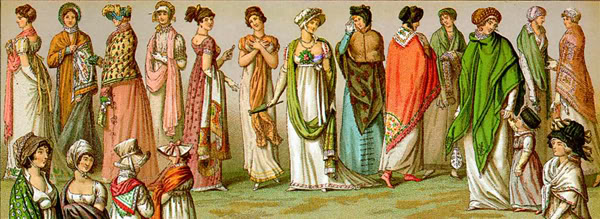
Jane Austen's Early Childhood and Schooling


Contrary to the accounts by the Austen family of Jane Austen's idyllic childhood in the warm bosom of her family, it has recently come to light that she was away from five out of the first eleven years of her life.

From three months to two years of her life, Jane was boarded with a nurse in the village of Steventon. She was then brought home till she was seven, at which point she was sent away to school. Despite the practice of Georgian times to send children away to boarding schools, girls were rarely sent until they were well into their teens. It was usually boys who were sent away to schools when they were twelve; fewer girls were sent.

So Jane being sent away was unusual in itself and an anomaly to be sent away so young. What's also strange is that she was sent away to a much inferior schooling than the one her father could've offered her at home. He was not discriminatory towards his girls and offered all his children the same scholarly teaching.

It is now generally believed that her parents, Rev. George and Cassandra Austen, wanted to make room for paying students to be housed at the rectory since they were perenially in debt, so the girls and then some of the boys had to be sent away to school. Eventually, all the boys went away, but the girls stayed home once they were older.

Friday, July 19, 2013


Picture Day Friday: Romance Novel Covers as Decoupaged Art on Shoes


Graduate student of romance fiction studies, Rudi Bremer, indulged in her love of romance novels and shoes by creating an art project, titled "The Sole of a Romantic."

Rudi says, "I've spent the past couple of weeks working on a visual art piece that celebrates my love of romance novels. My work is a pair of high heels that have been decoupaged with romance novel covers (both old skool and recent releases). They are entirely functional and I have plans to wear them ... pretty much everywhere. Essentially, they were for an assignment and will be in a small exhibition/showing."

Sarah Wendell called these shoes "The Most Awesome Shoes in the Universe."

And I have to agree. Take a look...


Wednesday, July 17, 2013


History Live! with Re-enactors in Northamptonshire, England


Kelmarsh Hall in Northamptonshire, England will be hosting Europe's biggest historical event, titled History Live! on July 20–21, 2013.

Over 2,000 re-enactors and performers bring two millennia of history to life through medieval jousts, Tudor combat displays, Norman battle re-enactments, Roman soldier parades, Regency wars, falconry, gladiators, and a host of interactive experiences.

Check this one out: "Our Victorian Gymkhana features both ladies and gentlemen competing in a series of relay races that require considerable skill, including the ability to carry a glass of champagne at full gallop (and drink it from the back of a horse!)"

"The BBC History Magazine Lecture Tent brings together some of Britain's finest historians and historical writers, giving visitors the opportunity to listen to talks and ask questions on some of the key moments in England's history."

This is so much fun! I'm totally green with envy at all those visitors who will be able to go to this. Oh, to be able to live on that side of the pond!

[Images courtesy of Point and Shoot Medieval Photography.]

Monday, July 15, 2013


Bronze Age Cape of Gold


Images of the Bronze Age Cape of Gold from Mold, Wales are copyrighted by the Trustees of the British Museum Images of the Bronze Age Cape of Gold from Mold, Wales are copyrighted by the Trustees of the British Museum The Mold Cape is a unique ceremonial cape of gold, made during the Early Bronze Age c.1900–1600 BCE, around 3,700 years ago. Made from a single sheet of beaten gold, it was found in Mold, Flintshire, Wales in 1833 at the centre of a circular mounded burial monument known as a barrow. Recent research of the burial site and the grave goods found there has suggested that the wearer of the cape may have been a woman.

[Images are copyrighted by the Trustees of the British Museum.]