Showing posts with label Business: Libraries. Show all posts

Monday, March 13, 2017


For WA State Indie & Self-Pub Writers from @kcls Public Library


The King County Public Library system provides an excellent service to the indie and self-published writers of Washington State.

You can submit your eBook to the KCLS collection with the Library Journal's SELF-e program by sending an EPUB2, EPUB3, or PDF file via this submission form.

You book will then be included in the SELF-e and Indie Washington collections of eBooks by local authors.

BiblioBoard is the platform that you will use to check out and read eBooks available via SELF-e and Indie WA.

Your book may be reviewed by Library Journal and may be included in the national SELF-e collection, thereby, being available across all participating libraries in the U.S. and Canada.

Friday, December 11, 2015


Picture Day Friday: Chatsworth Library


Chatsworth House is the seat of the dukes of Devonshire in Derbyshire, England. It is etched in the minds of Jane Austen fans as Darcy's Pemberley. A truly magnificent estate with a truly magnificent library. Here are some pictures.


[Image provenance unknown.]


[Image copyrighted by Mark C. Newton.]


[Image copyrighted by Sellers Abroad.]


[Image copyrighted by the British Magazine.]


[Image copyrighted by Imagine Arts.]

Tuesday, November 10, 2015


Philobiblon: The Love of Books


Richard de Bury was the Bishop of Durham in the 14th century. He was also known as Richard Aungerville or Aungervyle. He was tutor to the future King Edward III, a writer, and a bibliophile. Just before his death, he wrote a 20-chapter book called Philobiblon, which is considered the earliest books to discuss librarianship in-depth. In it he wrote about "how he collected his books, how they should be taken care of, and the many joys he found in them," according to Medievalists.net.

Here are a couple of extracts from his book:

We must consider what pleasantness if teaching there is in books, how easy, how secret! How safely we lay bare the poverty of human ignorance to books without feeling any shame! They are masters who instruct us without rod or ferule, without angry words, without clothes or money. If you come to them they are not asleep; if you ask and inquire of them they do not withdraw themselves; they do not chide if you make mistakes; they do not laugh at you if you are ignorant. O books, who alone are liberal and free, who give to all who ask of you and enfranchise all who serve you faithfully!

Books delight us, when prosperity smiles upon us; they comfort us inseparably when stormy fortune frowns on us. They lend validity to human compacts, and no serious judgments are propounded without their help. Arts and sciences, all the advantages of which no mind can enumerate, consist in books. How highly must we estimate the wondrous power of books, since through them we survey the utmost bounds of the world and time, and contemplate the things that are as well as those that are not, as it were in the mirror of eternity. In books we climb mountains and scan the deepest gulfs of abyss; in books we behold the finny tribes that may not exist outside their native waters, distinguish the properties of streams and springs and of various lands; from books we dig out gems and metals and the materials of every kind of mineral, and learn the virtues of herbs and trees and plants, and survey at will the progeny of Neptune, Ceres, and Pluto.

Tuesday, October 13, 2015


Going to the Library Can Make You Very Happy


OK, this is not just Keira being her usual rah-rah-rah BOOOOKKSS!!! There's apparently a study. And there's apparently data. It's legit.

The study is called Quantifying and Valuing the Wellbeing Impacts of Sport and Culture organized by the Department of Culture, Media, and Sport in the UK. "DCMS commissioned researchers from the London School of Economics (LSE) to undertake analysis of Understanding Society data to develop the evidence base on the wellbeing impacts of cultural engagement and sport participation."

Two of the findings of the study are: "A significant association was also found between frequent library use and reported wellbeing. Using libraries frequently was valued at £1,359 [$2,086] per person per year for library users." In fact, going to the library comes in a close third behind dancing and swimming in terms of a valued activity.

In a series of studies conducted by the Pew Research Center, it is found that "Libraries loom large in the public imagination, and are generally viewed very positively: 90% of Americans ages 16 and older say that the closing of their local public library would have an impact on their community." People feel that libraries give everyone a chance to succeed, promote literacy and a love of reading, and improve the quality of life in a community. For 75% of the people, it is important to have this quiet, safe place.

According to another Pew study, "The more people are engaged with their public library, the more they tend to feel connected to their community as a whole." Library users “are also more likely to say that they like their communities and that they would call their communities good or excellent places to live," Pew Research Associate Kathryn Zickuhr told TIME.

To us diehard readers and library users, libraries are priceless. A free library system is one of the central pillars of civilization.

That is why every year, we donate money to our library system. Some years, we earmark it for books, interlibrary loans, programs for young readers, book readings, and sometimes, we donate without instructions. We buy an annual Friends of the Library membership and buy books from their annual book sale. We also donate gently-used books.

Ever since I was young, I've visited libraries. I started my kids out at six months of age. I delight in looking back on our checkout histories. Just entering a library is like entering a church: the hushed atmosphere, the special fragrance, the joy the view brings (books as far as the eye can see), and the peace and contentment that seeps into my bones. The older the library, the more heightened the impact on my wellbeing.

Edited 11/6/15: The fabulous Ursula Le Guin on the importance of libraries. Marvelously put!

Friday, September 19, 2014


Picture Day Friday: The Old Library, Trinity College, Dublin


Friday, April 11, 2014


Picture Day Friday: Real Biblioteca in Madrid


This library in Madrid, Spain is called the Real Biblioteca del Monasterio de San Lorenzo del Escorial.

Wednesday, April 9, 2014


A Love Story of Oxford


I have much, much love for this travel memoir on the beauties of Oxford, it's history, it's grandeur, it's conveniences. In the summer of 2002, I paid a flying visit to Oxford under the aegis of a tour company. Whatever I saw, charmed me no end. Ever since, I've been dying to do a summer course there. Before then, I had been angling for a semester abroad. But all in all, life happened, and I have not been able to do it thus far. I'm still holding out hope that one day, I'll be able to wrangle a few summer weeks at one of the colleges. Oh, to have that happen!

(The picture is of Duke of Humfrey's reading room at the Bodelian Library in Oxford.)

Wednesday, March 5, 2014


British Library Digitized


Image provided courtesy of the British Library In a spirit of great devotion to scholarship rooted in the deep belief that knowledge must be widely shared, the British Library has released a million digitized images of 17th, 18th, and 19th century art from 65,000 volumes into the public domain and have made them freely available onto Flickr Commons. The images were digitized as a gift to the Library by Microsoft.

Image provided courtesy of the British Library "The images themselves cover a startling mix of subjects: There are maps, geological diagrams, beautiful illustrations, comical satire, illuminated and decorative letters, colourful illustrations, landscapes, [and] wall-paintings."

The Library says that this is an ongoing project, since only 65,000 books have been digitized thus far, and there are millions more books to go.

Image provided courtesy of the British Library Concurrently, the Library is going to open a crowdsourcing project to "help describe what the images portray," in a bid to tag them and index them properly for better discoverability through search mechanisms.

While all these images are freely available for you to download, manipulate, and display on your blogs, etc., the Library requests, as a gesture of goodwill, that you attribute the images to them. So, for example, if you hover over the image on the left, you can see my attribution.

Monday, February 17, 2014


A Librarian and an Author Explain What the Romance Genre Is


Image is copyrighted by NPR and the On Point with Tom Ashbrook radio show. With Valentine's Day just past and every news outlet, including NPR, scrambling to talk to romance writers and readers and to marvel at how much money this industry amasses, this interview by NPR's On Point with Tom Ashbrook with public librarian Wendy Crutcher and erotic romance author Angela Knight is very timely.

Have a listen here to the interview.

Here're some excerpts that I may have paraphrased as I typed as fast as my fingers were able to while listening to the podcast.

People who don't read romance have an idea of who reads romance: classic spinsters, unsatisfied housewives, women missing something from their real lives, etc. Rather, the readers cover every demographic, race, gender, economic scale, etc.

Almost all genre novels deal in positive endings. But romance gets knocked for it for being unrealistic.

It is insulting to imply that women are incapable of separating fiction from reality. [KS: Does this get said of sci-fi/fantasy novels or thrillers or murder mysteries?]

[Wendy:] People who read romance are looking for a good story that will sweep them up and carry them away, for strong emotional connections and human emotions, and for connections to the characters. I like when an author can make me forget that I'm reading about a fictional world with fictional people. I am looking for a little bit of emotional truth that speaks to me.

[Angela:] Basic core conflict in romance is always trust. Trust is the big defining thing in all relationships. If you can't trust somebody, then you don't have a relationship with that person. So romance novels work on establishing trust between the characters.

[Wendy:] Love and romance are universal desirable emotions. They're tangible, understandable, relatable emotions. People love the journey of the characters, the struggle, to get to love where they share their lives together.

[Wendy:] You know you're a great public library when there's something on your shelf to offend every person who walks in the door.

[Angela:] Ninety-nine percent of women write romance, 90% of women read romance, 90% of editors are women. So women are not constrained by what men might think about it. So in a sense it is a subversive feminist literature. Heroines do what they do because it enhances their lives.

[Male Caller:] I have read romance since I was fifteen. I still read them. I am disappointed that romance isn't marketed more towards male readers. I run a bookstore and have my collection is romance, because it's a genre that covers all the other genres. Emotional connections between individuals are missing from other genres like sci-fi, fantasy, and murder. So if you read romance, you can read romantic suspense to get the murder side of the stories and also the emotional connection.

Listen to the entire podcast to find out what romance is to modern-day readers.

Wednesday, July 31, 2013


Journal of Popular Romance Studies Call for Papers


CALL FOR PAPERS: Romancing the Library
Submissions are due by May 1, 2014.

Access to information is at the core of a library’s mission, whether it serves a public, academic, or special library audience. When it comes to romance novels, however, reader demand is often more than a library can meet, with constrained library budgets outstripped by the sheer volume of titles published each year. How, then, does a library decide which titles to purchase? What factors motivate selection or de-selection? How do the explicitness of love scenes and/or controversial subject matter shape that decision making process? Where does the line between selection and censorship lie?

Once an electronic or print title has been acquired, the library must decide where to house it within the collection and how best to inform readers of its existence. A library can create finding aids or subject guides, designate a specialist on the subject of romance, or find other ways to coordinate reference services around popular romance titles. What are the best practices for readers’ advisory and reference for romance? How are other media, such as romantic films or graphic novels, incorporated into reference services for romance novels? Is there a significant enough overlap between those audiences to warrant doing so?

The Journal of Popular Romance Studies (JPRS) seeks articles for a special issue on the intersection between romance and all types of libraries, anywhere in the world. This issue will discuss policy and practice, controversies, patterns and changes in the way that the library profession deals with popular romance fiction and with romance in other media (film, graphic novels, magazines) as well.

Submissions are particularly welcome on the following topics, although articles that examine other intersections between popular romance and libraries will also be considered for publication.

–Collection development policy, practice, and preservation
–E-books versus print books, publisher/vendor e-book check out and geographic limits
–Popular romance in special collections, browsing collections
–Defining a core collection of romance novels
–Censorship of popular romance in libraries
–Romance reference and readers’ advisory
–Romantic films and other media within the library

Submissions are due by May 1, 2014. This Special Issue of The Journal of Popular Romance Studies is being guest edited by Crystal Goldman. Please submit scholarly papers of no more than 10,000 words, including notes and bibliography, to An Goris, Managing Editor, at managing.editor@jprstudies.org. Submissions should be Microsoft Word documents, with citations in MLA format. For more information on how to submit a paper, please visit www.jprstudies.org/submissions.

Published by the International Association for the Study of Popular Romance (IASPR), the peer-reviewed Journal of Popular Romance Studies is the first academic journal to focus exclusively on representations of romantic love across national and disciplinary boundaries. Our editorial board includes representatives from Comparative Literature, English, Ethnomusicology, History, Religious Studies, Sociology, African Diaspora Studies, and other fields. JPRS is available without subscription at www.jprstudies.org.
Friday, March 29, 2013


Picture Day Friday: Cool Library of Montclair


This is the stairwell of the main branch of the Montclair Public Library in New Jersey. To me, this magical stairwell is emblematic of the magic of books.

[Image courtesy of Sarah Wendell.]

Wednesday, February 20, 2013


Modern Libraries as Community Centers


Carl Sagan said this of libraries: "The library connects us with the insight and knowledge, painfully extracted from Nature, of the greatest minds that ever were, with the best teachers, drawn from the entire planet and from all our history, to instruct us without tiring, and to inspire us to make our own contribution to the collective knowledge of the human species. I think the health of our civilization, the depth of our awareness about the underpinnings of our culture and our concern for the future can all be tested by how well we support our libraries."

In the face of vanishing libraries due to lack of governmental funding, this serves as a good reminder of the public good that libraries do for civilized societies. This also serves as a reminder of the main function of libraries as opposed to being community centers with computers, loud homework coaching sessions in the main halls, older teens getting together to eat dinner to the accompaniment of jokes and laughter, and music entertainment for the little ones, where the poor book stacks are being pushed against the walls in ever-reducing numbers.

So a few libraries across the nation have come up with creative ways to enforce a modicum of rules at their facilities.

From:

No chewing on headphone cords (in the children's section)

To:

Don't reach across my desk (in the YA section)

Then there's:

No reshelving even if you're a Library Science major (to prevent mis-filing, but even more importantly, to collect stats on which books get read how much for future buying and weeding out purposes)

And finally:

No bathing (for those downtown libraries that see a lot of homeless traffic)

Monday, March 14, 2011


Book Weeds


Libraries are "responding aggressively to market preferences" just like bookstores. That statement simply boggles the mind.

So, how do our local libraries determine the content of their collections? With limited funds and space, no library is ever truly all things to all people. Twenty-four months with no activity and the book is weeded out. Classics, novels, nonfiction, reference—nothing is exempt. If no one is reading them, librarians take them off the shelves and either sell them or dump them.

Public libraries have always purged old or unpopular books to make way for newer titles. However, these days, library administrators are calculating the system's return on its investment by each foot of space on the library shelves and figuring out which "products" will generate the biggest buzz.

While a part of me understands the economics behind this, the reader in me is horrified that those dusty tomes are no longer to be found in libraries. I consider free public access to all books to be one of the basic rights, ranking right up there with the freedom of speech. Never be able to read the classics is like losing a part of history—a history of the language, of thought, culture, society...of the very people.

So, what do you think about these necessary steps taken by libraries to stay current and afloat?

Sunday, January 25, 2009


Libraries Through The Ages


Loucinda McGary of the Romance Bandits, who blogged here about the Library of Celsius in the Roman city of Ephesus, present-day Turkey, said, "The library was heaven on earth for me, and I'm definitely not the only one." Indeed not.

Luis Siriano Biblioburro Colombia Even children in Colombia's war-weary Caribbean hinterland hunger for the books that only Luis Soriano can bring them. Every Saturday without fail, Soriano loads up his two donkeys Alfa and Beto with picture books, dictionaries, fables, and tales of derring-do and heads off into the small villages clinging to steep hillsides. His home has hardly any living space because it's stuffed to the rafters with books.

A whimsical riff on the bookmobile, Soriano's Biblioburro is a small institution: one man and two donkeys. He created it out of the simple belief that the act of taking books to people who do not have them can somehow improve the lives of the people of this impoverished region.

Jay Walker's Geek LibraryDiametrically opposite to this is Jay Walker's lavish Geek Library, a bibliographic equivalent of a Disney ride. The room occupies about 3,600 square feet on three mazelike levels with artifacts, such as the Sputnik, books bound in real rubies, a 1665 Bills of Mortality chronicle of London, and a framed napkin from 1943 on which Franklin D. Roosevelt outlined his plan to win World War II. There's even a massive "book" by the window, which is a specially commissioned, internally lit 2.5-ton Clyde Lynds sculpture.

Keira Soleore LibraryKeira Soleore Book PileBy far more modest is my library...

...and the spill-over from my library, that's most likely to go on IKEA bookshelves in the study but is now piled up sculpture-style in one corner of the living room.

Nalanda University LibraryLibrary of Angkor WatSince ancient times, libraries and learning have reserved a revered place in human society and culture. Take for example: the 3rd century BCE Library of Alexandra, the Buddhist Nalanda University from 500 CE India, engraved oracle bone repositories of 1700 BCE China, Sumerian clay tablets from 4,000 BCE Iraq, and a 200,000-volume Library of Pergamum in the Hellinistic Age.

Library of AlexandriaWhile I'm more likely to keep graveyard hours than those averred by an old Sumerian proverb: "He who would excel in the school of the scribes must rise with the dawn," I'm in awe of the fact that women in early Mesopotamia learned to read and write just like the men, and there were libraries in most towns and temples. The ancients were rather modern in their outlook, wouldn't you say?

University of California San Diego's Geisel LibraryVancouver LibrarySpeaking of modern, library building designs these days, range from odes to the Romans, like the Vancouver Library in B.C., to the high-tech space of Geisel Library on the grounds of the University of California in San Diego, and everything in between.

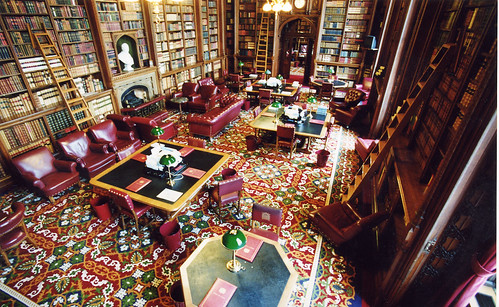
Now, here's a library I would looooooooove to have. Which is your Library of Drool?
Whether your library is a humble bookmobile that comes every Saturday to your neighborhood cul-de-sac or a multi-storey building in a prime downtown spot, do you frequent the place?

[Editied to add photos of the Library of the House of Lords, UK. Oceans of drool...]