

Showing posts with label Research: Languages. Show all posts

Tuesday, September 8, 2015


Old English Wisdom


Eleanor Parker tweets as A Clerk of Oxford and also Old English Wisdoms. I would like to be known as a boccræftig, a learned person; but alas! It is not to be so. In lieu of that, with Parker's permission, I have extracted a few Old English quotes from her tweets. All the translations are her own. The comprehensive list of "proverbs, maxims, and other miniature bits of wisdom and advice from Old English poetry and prose" is here.

As one poem says, Gleawe men sceolon gieddum wrixlan (wise men should exchange sayings), so I'm sharing some with you.

From Durham Cathedral, MS B. III. 32...

Geþyld byþ middes eades.
Patience is half of happiness.

Hwilum æfter medo menn mæst geþyrsteð.
Sometimes men are thirstiest after drinking mead.

Ne mæg man muþ fulne melewes habban and eac fyr blawan.
No one can have a mouth full of flour and also blow on a fire.

From The Seafarer from the Book Exeter...

Stieran mon sceal strongum mode, ond þæt on staþelum healdan.
One must steer a strong mind, and keep it steady.

From Widsith also from the Book of Exeter...

Sceal þeodna gehwylc þeawum lifgan.
Every ruler ought to live virtuously.
(Would that King Alfred the Great could rise from his grave and admonish our politicians!)

From Maxims I from the Book of Exeter...

Swa monige beoþ men ofer eorþan, swa beoþ modgeþoncas.
There are as many opinions as there are people on earth

From Solomon and Saturn II...

Bald bið se ðe onbyregeð boca cræftes.
Bold shall he be who tastes of the skill of books.

And my favorite one is from the poem Deor...

Þæs ofereode, þisses swa mæg.
That passed away; so will this.

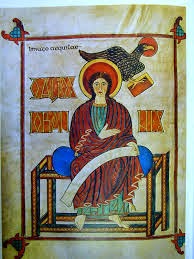
So why the picture of King Alfred the Great up top? "Alfred ... is closely associated, in history and legend, with teaching, translation, and the tradition of English 'wisdom.' Among his other achievements as king, Alfred arranged for the translation of—or perhaps even translated himself—a range of religious and philosophical texts into [Anglo-Saxon or Old] English, many of which have interesting things to say about how wisdom is to be gained and used."

Tuesday, July 7, 2015


Rare Book School at the University of Virginia


Every summer, the Rare Book School at the University of Virginia, Charlottesville hosts week-long courses in June and July in the history of books and manuscripts, book design, book binding, paleography, history of illustrations and letterforms, and so on. In addition, the school offers certificate programs in various concentrations. Here's an overview of the type of things people will learn.

If you cannot make it to Charlottesville in June and July, the school also offers courses in other states: Lilly Library at Indiana University Bloomington (May); the Kislak Center for Special Collections, Rare Books and Manuscripts at the University of Pennsylvania and the Library Company of Philadelphia in Philadelphia (July); at the Library of Congress in Washington (July); and at the Grolier Club and the New York Public Library in New York (October).

Prices are steep ($1295 per week) and the hours long and intense. If you cannot make it to any of the courses this or any other year, the school offers up for free advanced reading lists for all its courses. Students are required to have all the reading done before they arrive for the course.

Let me dream here. If I could've been in Charlottesville in June and July, this is what I would've taken:

June 7-12: Reference Sources for Researching Rare Books

June 14-19: The History of the Book, 200–2000; Introduction to Paleography, 800–1500; Printed Books to 1800: Description & Analysis

July 5-10: Advanced Seminar in the History of Bookbinding

July 19-24: Rare Book Cataloging; The Handwriting & Culture of Early Modern English Manuscripts

July 26-31: Provenance: Tracing Owners & Collections

Tuesday, June 9, 2015


Medieval Manuscripts Paleography Summer School


The University of London's Institute of English Studies is offering a summer school in medieval manuscripts studies and paleography in June this year. Subject areas include Latin, English, Anglo-Saxon, German, and Greek paleography; history of scripts; illuminated manuscripts; codicology; vernacular editing; and liturgical and devotional manuscripts.

The summer school is hosted by the Centre for Manuscript and Print Studies with the co-operation of the British Library, the Institute of Historical Research, Senate House Library, the Warburg Institute, University College, King's College London, and the Victoria and Albert Museum.

After half a year of online medieval manuscript studies offered by Stanford and Cambridge universities, titled Digging Deeper 1 and Digging Deeper 2, this summer school sounds like a heaven-sent opportunity to further my education in paleography (study of medieval scripts) and others areas of manuscript studies. Unfortunately, this is not something I can take up.

But if I were to go, these are the courses I would've signed up for:
—Introduction to the Insular System of Scripts to 900 A.D.
—Approaches to the Art of Insular Manuscripts
—Liturgical and Devotional Manuscripts I
—Liturgical & Devotional Manuscripts II
—Introduction to Latin Paleography
—Intermediate Latin Palaeography
—Intermediate Old English Paleography

The London Rare Books School also offers the following week-long courses with paleographical content: The Medieval Book, The Book in the Ancient World, and Latin Paleography. In July, it'll be offering an Introduction to Latin Paleography course.

Friday, January 9, 2015


Picture Day Friday: Lindisfarne Gospels


From the British Library: "The Lindisfarne Gospels, one of the greatest treasures in the British Library’s collections, is now back on display in The Sir John Ritblat Gallery. This Latin Gospel-book is thought to be the work of one remarkably gifted scribe and artist, who created it around 700 on the Holy Island of Lindisfarne, Northumbria. Its importance lies not only in the beauty of its carpet-pages and its miniatures of the four Evangelists, but also in the tenth-century gloss of its text that is the earliest example of the Gospels in the English language."


Friday, December 12, 2014


Video Day Friday: Beowulf in Old English


Have a listen to the prose-poem Beowulf as read in the original Old English language.


From Open Culture: "As you can hear in the Beowulf reading above from The Telegraph, it’s a thick, consonant-rich language that may put you in mind of J.R.R. Tolkien’s elvish. The language arrived in Briton—previously inhabited by Celtic speakers—sometime in the fifth century, though whether the Anglo-Saxon invasion was a hostile takeover by Germanic mercenaries or a slow population drift that introduced a new ethnicity is a matter of some dispute. Nevertheless it’s obvious from the reading above—and from texts in the language like this online [written] edition of Beowulf in its original tongue—that we would no more be able to speak to the Anglo-Saxons than we would to the Picts and Scots they conquered."

Monday, April 14, 2014


Conference on Women in Anglo-Saxon England


Starting tomorrow, the University of Manchester is hosting a three-day medieval conference at Hulme Hall in the Victoria Park area of Manchester.

For £90 (£60 for students and state-dependent individuals), you're allowed to attend the lectures and discussions and partake of the refreshments and the wine reception at the Women in Anglo-Saxon England conference. The conference runs April 15–17.

Some of the interesting talks that I'd love to attend are:

The Wife’s Lament: Possibly the Most Perfect Anglo Saxon Riddle Ever Written

Embroidery Workshops

Women's work in Anglo-Saxon food production

Vocabulary for Man, Woman and Person in Old English Prose

Female names in Old English

Women's health

Female Power and Authority in the Seventh Century

Early Anglo-Saxon elite female jewelry

Female Identity and Foster-Relationships in Old English Literature

Scholarly Women of the Later Seventh Century: Learning, Liturgy and Luxury: an insight through the words of Aldhelm of Malmesbury, first Bishop of Sherborn

Thursday, March 11, 2010


Boke of Cookry: Hazelnut Sauce


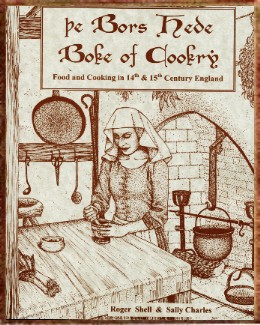
Copyright Camlann.org and Robert ShellI blogged HERE about Þe Bors Hede Boke of Cookry and the recipe for Frytor of Erbys. Here's another recipe...

COUDRE EN TENS DE NOIS

Middle English

Milke of alemauns • flour of rys • curneles of nuten ifried • gynger itried • sucre vort abaten Þe keneschype • nuten yfried abouen

—"Diuersa Cibaria", London BL Add. 46919 and Anglo-Norman recipes from early 14th century

Modern Translation

Hazel-nuts in season, almond milk, rice flour, friend nut kernels, fresh peeled ginger, sugar to abate the sharpness, topped with fried nuts.

Working Recipe

1 c hazelnuts, chopped
1 Tbsp butter
2 Tbsp rice flour
1 tsp fresh ginger, pared and minced
2 Tbsp sugar
3/4 c white wine
2 Tbsp lemon juice
1/4 cup blanched almonds, pulverized

In a small frypan over medium heat, fry chopped hazelnuts in butter until golden. In a small saucepan, stir wine, lemon juice, almonds, and rice flour until well blended. Add ginger, sugar, and half the fried hazelnuts. Cook over medium heat until thickened. Garnish with remaining hazelnuts. Serve over roasted salmon.

Tuesday, February 9, 2010


Boke of Cookry: Frytor of Erbys


Inspired by Nicola Cornick's cooking post, this is mine. Having eaten at this place many times and tried out the recipes at home, I can personally attest to the fabulosity of this restaurant and book.

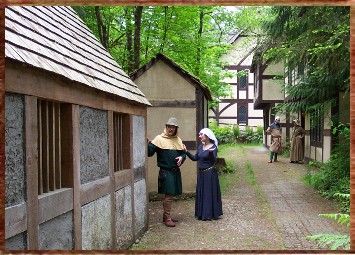
Copyright Camlann.org and Robert ShellÞe Bors Hede Inne is part of the Camlann Medieval Village: a Living History Museum project. Camlann re-creates the every-day experience of a 14th century rural village typical of Somerset, England for the study, interpretation, and enjoyment of medieval arts and culture.

Copyright Camlann.org and Robert ShellÞe Bors Hede Boke of Cookry is a unique, illustrated, 214-page work that contains 101 recipes in Middle English with modern translations and modern working recipes. Introductory chapters explain food, gardens, kitchens, cooking techniques, and meals in the Middle Ages. There's also a 85-page glossary of Middle English culinary terms. A veritable goldmine research guide for the medieval historical writer.

FRYTOR OF ERBYS

Middle English

Take gode erbys • grynde hē and medle hē wt flo~ and wat~ & a lytel ȝest and salt • and frye hē ī oyle • and ete hē wt clere hony

—"The Forme of Cury", London BL Add. 5016, a 15th C. copy of a 1390 compilation, translated by Samuel Pegge

Modern Translation

Take good herbs, grind them, and mix them with flour and water and a little yeast and salt, and fry them in oil, and eat them with clear honey.

Working Recipe

1 package dry yeast
1/4 cup warm water
1 cup fresh herbs (mustard greens, parsley, anise, and cilantro)
2 cups flour
2 1/4 cups cool water
1/2 tsp salt
1/4 cup honey
oil for frying

Dissolve yeast in warm water; set aside. Wash and dry herbs; mince. Mix flour and cool water together; add dissolved yeast, salt, and herbs. Cover and allow to sit in a warm place for one hour. Heat oil in deep fat fryer to 375oF. Drop spoonfuls of batter into fat and fry until golden, turning once. Drain and serve drizzled with honey.