WARNING: If you haven't read This Body of Death by Elizabeth George or any of the three prior books and are planning on doing so, then please do not read this post further. SPOILERS abound!
 American Author Elizabeth George writes mysteries in the grand old tradition of British Classic Crime novels started in the Golden Age between the two world wars. That tradition has been carried into modern times by P.D. James, Ruth Rendell, Deborah Crombie, and George among others.
Mysteries are fictional novels blah blah blah. Characters are the purview of the author blah blah blah. Continuing characters can be taken in any direction that the author wishes to do so blah blah blah.
And yet... I felt devastated by George's April book This Body of Death. The reasons for this are two-fold. But first, a preamble...
I have read every one of her books. George was the reason I was introduced to the world of Brit Classic Crime—intellectual, realistic, and not unnecessarily gory or terrifying simply for the sake of jerking the reader's chain. However, George's books have gotten progressively darker. So far, I kept faith, because of the integrity and complexity of her protagonists and stories. I genuinely like(d) them.
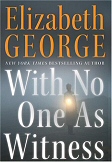 For many fans, the ending of With No One As Witness was a huge shock and cause for disenchantment. For me, the ending and Lynley's reactions were very much on par for the story, series, and character arcs that George had set in motion. For me, the horror was in the next book What Came Before He Shot Her, which contains children doing terrible things to other children and having terrible things done to them in turn. (As a book in a continuing character series, the fascinating part was that this next book was a prequel to the former book. Cleverly done, with a gutsy writerly approach.)
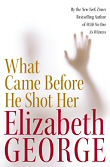 Violence towards children is a deal-breaker for me. Usually. For George's sake, I was willing to assume that the stuff in What Came Before He Shot Her was a one-off. However, two books later, in This Body of Death, juvenile voilence is back and the atrocity is far more gruesome. Involves a small child, too.
Detective Inspector Lynley of the Scotland Yard is a peer of the realm, a belted earl complete with a butler, wealth, fabulous education, and a great big pile in Cornwall. And yet, he feels compelled to work as a policeman. In Lynley, George has also created a roué who goes through the Metropolitan Police department females chapter and verse. This isn't conjecture on my part, but related through the eyes of his Detective Sergeant Barbara Havers. Thank the gods that he hasn't banged Havers yet. Lynley has no moral, ethical, or even health reasons for abstaining—the only reason being that he so out-classes her. Modern Brtish society is still rife with class distinctions. A nobleman cannot conceive of playing tickle-n-poke with a person of the lower middle classes. In This Body of Death, Lynley's monologue shows that he's aware of Havers's interest in him, but his involvement with her is "laughable."
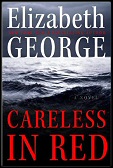 Now in Careless in Red, Lynley is suffering through intense grief following a traumatic event. He takes off on a solitary walking journey of the west coast that's equal parts endurance and healing, following days of a drinking binge. In the course of the story, he gets involved in solving a local crime and also having it on with the principle suspect. (wry) I'm still willing to give George and Lynley leeway here, because I think this promiscuousness is another expression of grief. After all he had reformed while he was married.
 Then along comes This Body of Death, and Lynley is back at the Met and back at having the hots for the new department woman, his superintendent, this time. Isabelle Ardery is a poor investigator, doesn't know how to hold a team together or lead, jumps to conclusions on thinest circumstantial evidence, treats the people working for her badly, treats Lynley like her go-fer, is an alchoholic...but never mind, Lynley is still interested. I'm still reading, mind, because perhaps George in her great talent might redress matters here. Nope. Lynley catches her in her apartment passed out drunk, sticks her in the shower with her clothes on to revive her, makes her coffee and toast to sober her up, and then sleeps with her. And then proceeds to tell Assistant Commissioner David Hillier that he should keep her on, because this case wasn't a fair test of her skills.
Arrrrrggghhhh!!!! I give up! Given what I read and what I write, I'm hardly a prosing bore about sexual morals in fictional characters. However, a modern titled rake who can't keep his pants zipped except for the brief period of his marriage with no thought for protection against STDs is completely unbelievabe to me. Does he have no discernment? No dignity, sense of self-respect? Or is that the point? Either way, I have lost interest in seeing whether Lynley will end up with Havers and/or reading the dark, seediness that pervades her books these days. And I mourn the loss.








 In his critique, Tolstoy wrote, "I remember the astonishment I felt when I first read Shakespeare. I expected to receive a powerful aesthetic pleasure, but having read, one after the other, works regarded as his best: King Lear, Romeo and Juliet, Hamlet, and Macbeth, not only did I feel no delight, but I felt an irresistible repulsion and tedium..." He further characterized Shakespeare as "a bad dramatist and not a true artist at all."
 To this, Orwell wrote, "One's first feeling is that in describing Shakespeare as a bad writer he is saying something demonstrably untrue. But this is not the case. In reality, there is no kind of evidence or argument by which one can show that Shakespeare, or any other writer, is 'good.' Artistic theories such as Tolstoy's are quite worthless, because they not only start out with arbitrary assumptions, but depend on vague terms ('sincere,' 'important,' and so forth) which can be interpreted in any way one chooses. Properly speaking one cannot answer Tolstoy's attack."
 So whenever romance novels of hugely successful writers come under attack as lacking in literary gravitas, it's important to bear in mind what's really important: the opinions of an opinionated few or the opinions of the wide reading populace, speaking loudly with their hard earned money and even harder earned time. No arguments need to be made of good prose, nuanced imagery, complex emotions, accurate historicals details, etc. etc. The readers have spoken.