
Picture Day Friday

Posted on:
2/17/2012 12:01:00 AM








Holiday House is an early 19th century Regency house located on Church Street adjoining Catton Park, Norwich that's up for sale.
Go here to drool over photographs, descriptions, and floor plans of this beautiful house. Doesn't it make you want to just dream over it?
Built circa 1820, the house is said to have a Gothic influence (see the windows) and is situated in approximately half an acre of private gardens that are a riot of color and include a lily pond. Yew, holly, and evergreen hedges border the garden to keep the beauty private.
The roof still continues to be a thatched roof. The windows are deeply set with window seats and in-wall cupboards on either side. The house has been renovated on the inside and has a sitting room, dinning room, kitchen, and utility rooms on the first floor and four bedrooms on the second floor. Modern touches such as granite and electric ovens in the kitchen, underfloor heating, plumbing for washing machines, and a Jacuzzi make Holiday House eminently livable. Don't you just want to run over there and make it your own?
A little tidbit, the village of Old Catton was the home of Anna Sewell, the author of Black Beauty.
Posted on:
2/13/2012 12:32:00 AM
Stairway to bookish heaven (or to my dream home office)...

Posted on:
2/10/2012 12:26:00 AM
Reposting blog from January 24, 2011.
 I like my life scheduled. There, I admitted that up front, so that when we get into the nitty-gritty of this post, you're not blindsided by this epiphany: Gosh, she's so Type-A.
 I use this weekly paper scheduler and a print-out of my Excel file schedule to keep me on track with my goals and where I need to be. The book schedule has the outdoor commitments and the paper schedule is the day-to-day stuff that I must do in order to fulfill my career, family, health, volunteer, etc. goals. I use this planning journal to record what I've planned on a day-to-day basis and what I've accomplished. Also noted are exceptions to the schedule and why.
 Map a typical day in an Excel spreadsheet or on tabulated paper from the time you wake up to the time you fall asleep. See how current actions naturally work on some of the goals you've set up for the year. Then plan the remaining goals in the time left to ensure that your goals are being met on a regular basis.
 If you don't label your time to dedicated actions, then that piece of time is either attached to another task or frittered away. "It'll take you longer to use your time" (i.e., less efficient use of time) "if you have to decide what to do with it first," says aspiring writer Lacey Kaye.
 Once you've done the thinking and the planning, then at the appointment time all you have to do is "just do it," as Nike would say. However, when doing the assigned task, focus only on that task; don't even think about anything else. "If you've come up with an efficient best process, then anything you do that's not that process is a waste of time," advises Lacey.
 She further says, "Working to a schedule helps so much with identifying the opportunity cost of missing a meeting." What that means is that if you miss a scheduled appointment, move on. In other words, don't rob Peter to pay Paul. Move the assigned task in the missed slot to next day's slot for the same task.
Author Erica Ridley says, "The most basic rule of thumb when keeping to a schedule is: There is no making up lost time."
My daily mantra is: Respect my schedule. Follow the plan.
Posted on:
2/08/2012 12:25:00 AM
Reposting blog from January 19, 2011.
 The month of January is when people make decisions about their new year's resolutions. As the Dalai Lama says, "The purpose of our life is positive; we weren't born to failure and disappointments." So despite non-compliance of previous year's resolutions, every year, people make new ones for the shiny, bright, new year. We have hope that this will be the year we will....
These days, resolutions has become a word oft shunned in public forums (fora?) and the word goals is much touted. However, a resolution is merely a committment to a goal. Whereas, a goal is something you aspire to, when you resolve to take steps to accomplish a goal, you're in the docket for it; you're committed to doing it. So, this year, my resolutions document is called Keira's Commitments.
 However, for the sake of this post and the common knowledge associated with the word, I'll use goals in place of commitments.
Goals give you something concrete to work towards and to measure progress against. Goals also give you a sense of accomplisment once you've reached them, because if someone doesn't really know what he wants, he does nothing and remains unsatisfied and unhappy with his life.
Author Erica Ridley says, "If a goal isn't realistically possible, then you set yourself up for disappointment." Even if it is possible, the question to ask is: Is it plausible for you? Is it advisable for you? Erica also notes that "If a goal is not attainable based wholly on your skills, talent, ability, and willpower," then it must not be a goal. Do not give yourself impossible tasks.
 So, what is the basic format of a goal? There's a title or logline; an execution plan that's realistic, specific, and measurable; and there are accountabilities each of which are timed, specific, and action-oriented.
Part of being accountable, goals must be achieved within a reasonable set time period. The deadline must include a reasonable buffer to accomodate delays out of your control. Note that having set up goals gives a sense of accomplishment. However, this does not mean you're partway towards accomplishing them. In order to achieve a goal, you must work towards it. "Goals do not achieve themselves." Also as editor and publisher Moira Allen puts it, "Goals are not your destiny. They are simply highly effective tools that you can use to reach that destiny."
So how do you go about achieving your goals. First, come up with concrete goals that follow the basic format mentioned above. "Vague goals are just New Year's resolutions that remain on the list year after year," says Sheri McGregor of MothersWhoDream.com.
 Then, break down each goal into bite-sized mini goals. Assign a dealine to each bit. "To maintain and intensify your desire," says romance writer Jessica Davidson, "write out a list of all the benefits and advantages to achieving your goals." Now list obstacles to achieving every mini goal and solutions to the problems. I use a planning journal by At-A-Glance. In the planning journal, set out your main goals and mini goals with deadlines for both. Journal progress (or lack thereof) made on each goal.
Finally, visualize periodically to strengthen resolve to do it. Turn the "I can't do this" thought process into a "How can I do this?" thought process. And try, try, try!
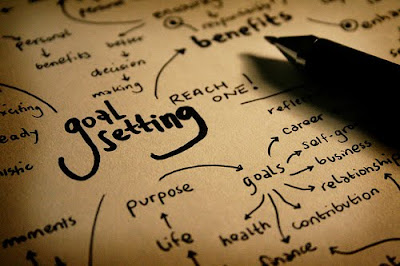 What is the difference between short-term (ST) goals and long-term (LT) goals? While long LT goals help you determine where you're going, ST goals help you decide how to get there. For example, ST writing goals can be measuring monthly page output or estimating when the novel will be finished, whereas LT writing measured by big results: getting an agent or selling to a publisher. You control the ST goals; you do not control the LT goals. This is a key point. ST goals under your sphere of influence. LT goals outside your sphere of influence. You can do all the ST goals perfectly but there's an additional outside factor to achieving LT goals that can be best described as happenstance. That is not to say that you shouldn't work hard on your LT goals. There's a saying that goes: "Chance favors the prepared mind." So, too, with achieving LT goals.
 Short-term goals and long-term goals are not to be confused with main goals and mini goals. Both ST and LT goals are main ones that have baby-step goals. So for example, if your ST is to write a novel is X months, then some of the mini goals would be: research for A days, write B words every weekday, edit every Satuday, Sunday is catch-up day, and so on. Similarly, if your LT goals is to get an agent, your mini goals might be: attend a conference, read the Guide to Literary Agents, read books agented by your top few favorites, etc. etc. Another example of a long term goals might be one from your Life List.
 And finally, a reminder from Voltaire: "Don't let the perfect be the enemy of the good." Don't allow the desire for everything to be done perfectly stump your motivation and lead you into procrastinating the very thing you want to achieve.
Posted on:
2/06/2012 12:22:00 AM
