Friday, April 13, 2012


Picture Day Friday: Little Free Library


The mission of Little Free Library is to promote literacy and the love of reading by building free book exchanges worldwide.

It all started three years ago, when "Todd Bol came up with an idea to remember his mother, a teacher who had loved books and encouraged people to read. At his home in Hudson, WI, he built a box, made it waterproof and filled it with books. It looked like a miniature one-room schoolhouse, with a sign underneath that said 'Free Book Exchange.' Bol put it on a post outside of his house and invited neighbors to take a book, and return a book. 'People of all ages, men, women, kids came up and just loved the library,' Bol said. 'They got excited and they started coming up to me saying, "I’ll build one, do you need books?"'" And the idea took off. Now there are Little Free Libraries in at least 28 states and six countries. (More coverage on this story is HERE.)


Wednesday, April 11, 2012


Do You Write In The Margins?


Image copyrighted by io9.com There are people who are vehemently opposed to defacing books, inside and out. Many take great care not to crack the spines of mass market paperbacks or dent the dust jackets of hardcovers.

Me? I like to write margin notes. I highlight relevant lines. My paperbacks don't have uncreased spines. My dust jackets might end up with creases and minute tears. About the only thing I will not do is dog-ear the pages.

Looks like I am in ancient company. Even those monk scribes who laboriously worked for months on a single illuminated manuscript, tended to leave margin notes.

The following, unintentionally humorous, GEMS come from the spring 2012 issue of Lapham's Quarterly, entitled Means of Communication. Thanks to Brain Pickings for bringing them to my attention.

Image copyrighted by FreeChristImages.org The parchment is hairy.

Oh, my hand.

Thank God, it will soon be dark.

Writing is exessive drudgery. It crooks your back, it dims your sight, it twists your stomach and your sides.

As the harbor is welcome to the sailor, so is the last line to the scribe.

Now I have written the whole thing: for Christ's sake give me a drink.

My justification for marginalia comes from How to Read a Book by Mortimer Adler (1940).

"When you buy a book, you establish a property right in it, just as you do in clothes or furniture when you buy and pay for them. But the act of purchase is actually only the prelude to possession in the case of a book. Full ownership of a book only comes when you have made it a part of yourself, and the best way to make yourself a part of it—which comes to the same thing—is by writing in it."

"Reading a book should be a conversation between you and the author. Marking a book is literally an expression of your differences or your agreements with the author. It is the highest respect you can pay him."

Does that make you want to take a pen to your books?

Monday, April 9, 2012


My Home Library


Image copyrighted by DaVinciInstitute.com

Whenever I meet new people or visit people's houses, books always seem to crop up in the conversations. And I find I'm unfailingly interested in people's book collections. What someone reads tells me a lot about the kind of person he or she is. Assuming as my blog reader, you're likewise interested in my home library, here're a few questions I posed to myself and answered herein.

Where is your home library housed?

The library is split up into three pieces. Adult fiction is in the study upstairs, children's books actively being read are in a bedroom upstairs, and the rest of the collection (nonfiction, children's books, coffee-table books, etc.) are all in the library downstairs.

What is the system of book organization?

The fiction is alphabetized by author only and unsorted within each author section. The bookshelves consist of smallish rectangular boxes, each alphabet gets one or more boxes, depending upon the number of books. The children's books, upstairs, are organized by author only and not alphabetically. The children's books, downstairs, are completely unorganized, except for board books on one shelf and the rest on another. The nonfiction is organized thematically, for example, sciences, travel, foreign languages, cookbooks, etc., but unorganized within each category.

Approximately, how many books do you own?

~2000

What was the first book you were gifted with?

The Little Prince by Antoine de Saint-Exupéry, translated into English by Katherine Woods and published by Harcourt, Brace & World in NYC in 1943. My mother owned it before she was married, and she gave it to me when I was born.

Which books did you buy first?

Four books in 1979:
—The Mutiny of Board H.M.S. Bounty by William Bligh, adapted by Deborah Kestel and pubbed by Playmore Inc. under arrangement with Waldman and Son, NYC (1979)
—Through the Looking Glass and What Alice Found There by Lewis Carroll, pubbed by Piccolo Pan Books, London (1977)
—Man in the Sky: the early years by Althea Braithwaite, pubbed by Colourmaster International, Huntingon England (1972) —The Littles Go Exploring by John Peterson, pubbed by Scholastic (1978)

Which is the book with the oldest copyright in your collection?

The Cousins by Maria M'Intosh is a children's book pubbed by George Routledge and Sons of Ludgate, London. The copyright page has been lost, but the last known owner was one Emily P. Mason. Her name's inscribed inside along with the date January 1, 1882. I bought it from Barter Books in Alnwick, Northumberland, England on June 26, 2002.

What are your most unusual books?

—Seven Poems by Hans Christian Andersen, translated into English by R.P. Keigwin, published by H.C. Andersen Hus in Odense, Denmark in 1955. I acquired this collection from the Andersen House in Odense on July 10, 2002. In the western world, Andersen is not known for his verse, though he wrote quite a bit in his salad days, including one when he was but a schoolboy. A few of his poems have been set to song and are very popular as national songs.

—Why I Live On The Mountain is a collection of thirty Chinese poems from the Great Dynasties, translated by C.H. Kwôck and Vincent McHugh, with calligraphy by John Way, and pubbed by Golden Mountain Press, San Francisco in 1958.

Which is the shortest book, in terms of number of words?

Baby Face by Dorling Kindersley (2002) has 18 words.

Which is the longest book, in terms of number of words?

I have a hardcover collected edition of 566 pages by Wings Books, Random House (NYC, 1991) of three of Dorothy Sayers books: Strong POison (1930), Have his Carcase (1932), and Unnatural Death (1927). (Aside: Sayers's full name is Dorothy Leigh Sayers Fleming.)

Are you a hardcover book collector?

I haven't gone out of my way to collect hardcover books. If the book I'm interested in buying only exists in hardcover, then I'll buy it. Otherwise, whatever is the cheapest edition, gets my money.

Has your library grown steadily since your first purchase?

Not at all. My collection was tiny through all my schooling and college years—I borrowed heavily from friends and libraries. It's only when I got my first full-time job that I had the spare cash to purchase books. Even then, I read far more from the library than I bought from the bookstore. It was finally when I became an aspiring writer of historical romance fiction that I started collecting books in earnest. I needed books on the craft of writing, for research, and as examples of writing in my sub-genre. In addition, I felt that if I expected others to buy my future books (when—not, if—pubbed), I should be doing the same thing for other authors.

Friday, April 6, 2012


Picture Day Friday: Book Crate Bed


Richard Avedon's Book Crate Bed

Wednesday, April 4, 2012


Seattle's Edible Book Festival


Image Copyright FryBooks_blogspot_com "Eat a Book Today" is the motto of The Edible Book Festival "celebrating books and food and the people who love them." It is organized by the Seattle Center for Book Arts. This year was the seventh annual event on March 31.

If you make and take an entry to the event, entrance is free, but prior registration is required. If you're only going to watch (and eat!), then there's a fee of $10 per person.

Image Copyright Keira SoleoreEvery year, the emcee of the event is someone hamming up as a literary figure in costume. Last year, it was Julia Child; this year, it was Ben Franklin.

Schedule of Events:
• 11:00 to 12:00 Entries accepted, installed, photographed
• 12:00 to 1:30 Public viewing and voting for Best in Show
• 1:30 Celebrity Judges award prizes
• 2:00 Edible Books eaten with tea, coffee, milk

Categories:
• Most Pun-derful
• Most Drop-dead Gorgeous
• Most Delectably Appetizing
• Best Young Edible Artist (K-12)
• Best in Show

Instructions:
"Create and bring a piece of edible art related to books: it can pun on a title, refer to a scene or character, look like a book (or a paper, a scroll, etc.), or just have something to do with books. Whatever the inspiration—it must be edible. Think of brainy, beautiful, silly, clever, and tasty transubstantiations of books we love into treats we eat! Every type of book—children's classics, detective novels, biographies, fiction and non, poetry, short stories—should be sculpted from a smörgåsbord of foodstuffs. Supply a placard with the title of your piece and your name." Also include the book you're riffing of.

The following images are all photographs taken by me. Commentary follows each picture. Click on the image to get a bigger, better view.

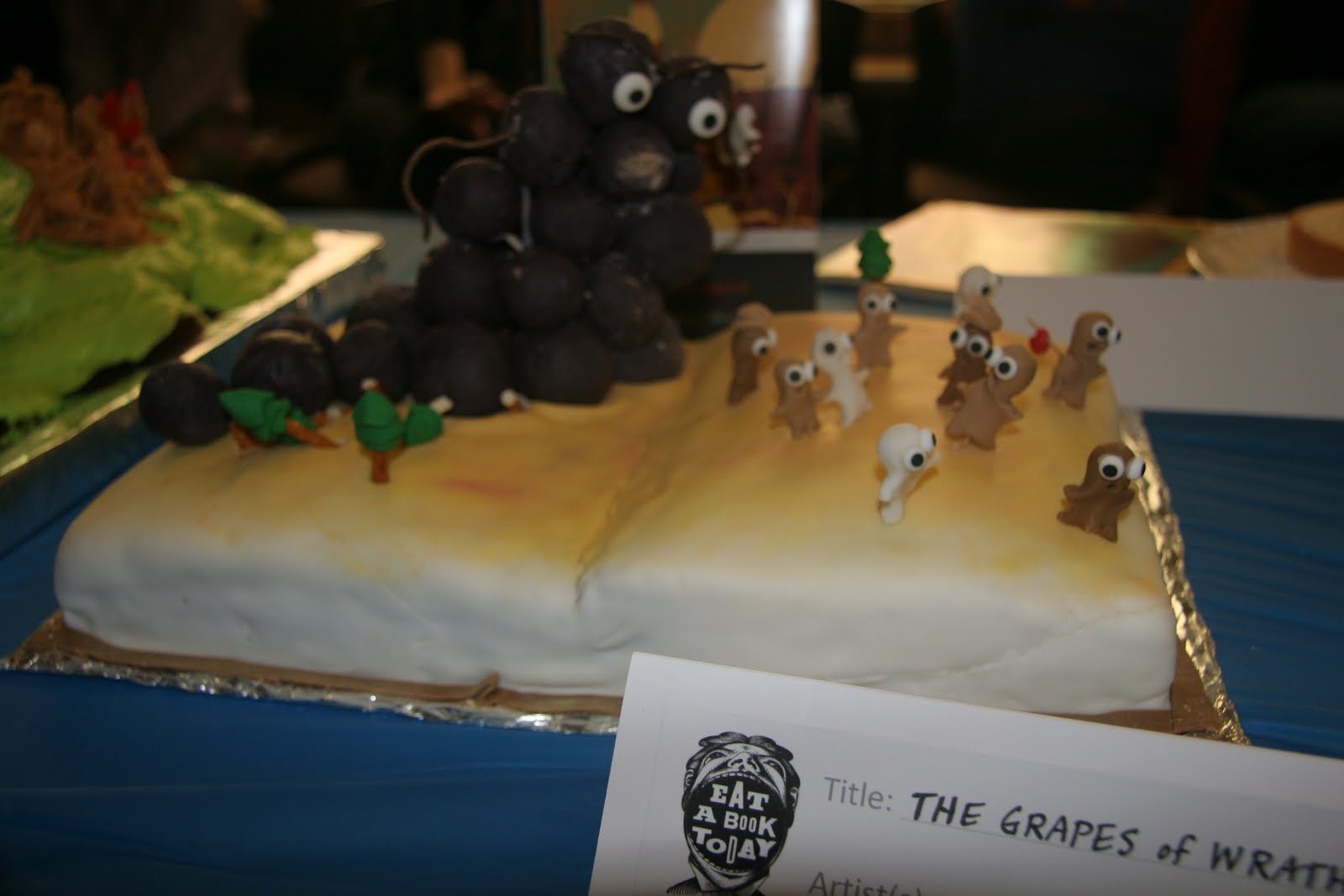
Grapes of Wrath by John Steinbeck

Image Copyright Keira Soleore


Le Petit-Four Prince from Le Petit Prince or The Little Prince by Antoine de Saint-Exupéry

Image Copyright Keira Soleore


Oh, those poor bleeding arms in Farewell to Arms by Hemmingway

Image Copyright Keira Soleore


Delicious panna cotta in Drawing on the Right Side of the Brainna Cotta from Drawing on the Right Side of the Brain by Betty Edwards

Image Copyright Keira Soleore


Harry Potter and the Deadly Challah-ohs

Image Copyright Keira Soleore


Call of the Wild Rice from Call of the Wild by Jack London

Image Copyright Keira Soleore


The magnificient breaded dragon is holding sway over cheese in The Girl with the Dragon Fondue

Image Copyright Keira Soleore


Image Copyright Keira Soleore


Check out the hellfire in Satanic Purses from Satanic Verses by Salman Rushdie

Image Copyright Keira Soleore


Grilled with a Dragon Tattoo

Image Copyright Keira Soleore


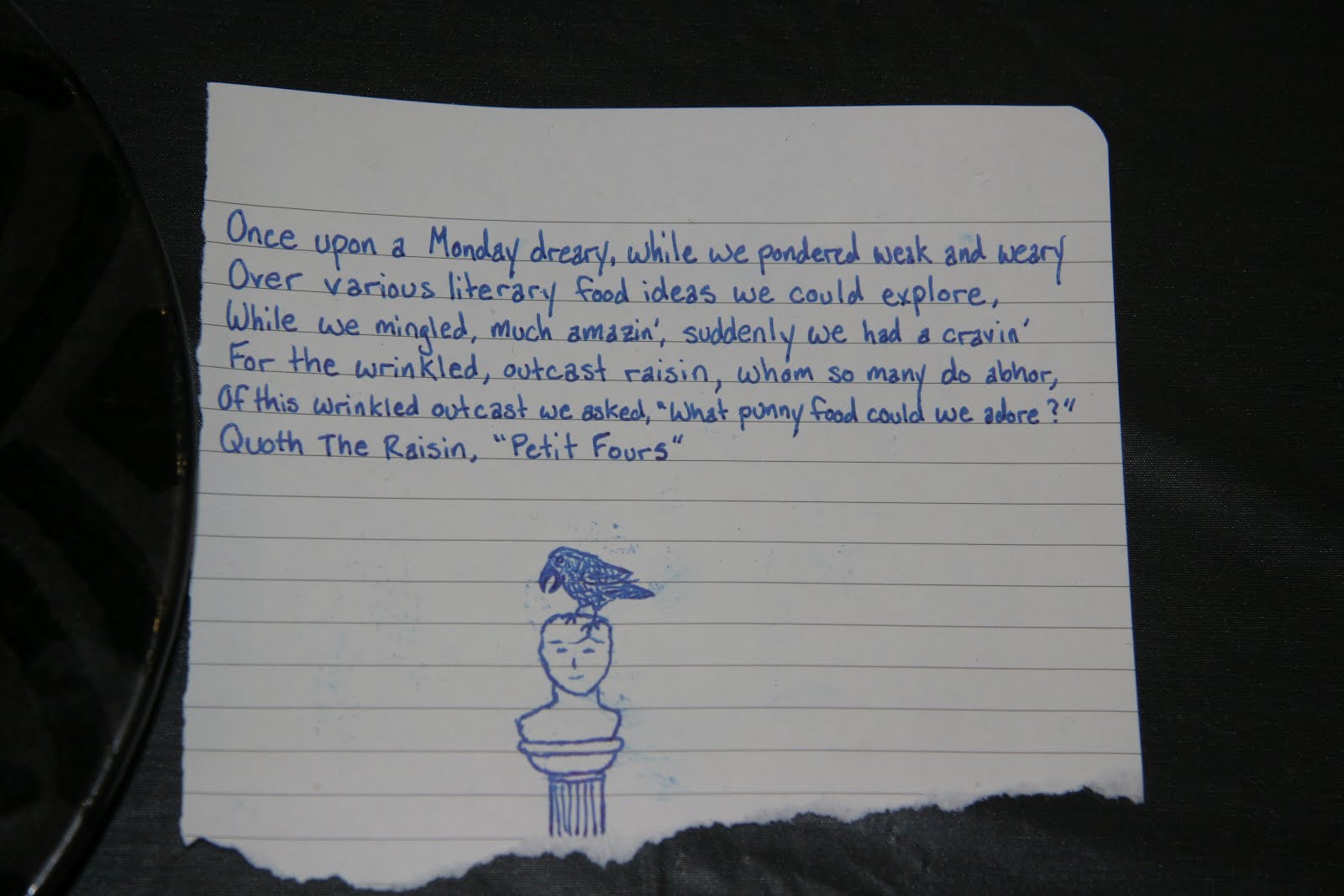
The pièce de resistance of the show: Quoth the Raisin "Petit Four" from The Raven by Edgar Allan Poe.

Image Copyright Keira Soleore

Once upon a midnight dreary, while I pondered weak and weary,
Over many a quaint and curious volume of forgotten lore,
While I nodded, nearly napping, suddenly there came a tapping,
As of some one gently rapping, rapping at my chamber door.
`'Tis some visitor,' I muttered, `tapping at my chamber door -
Only this, and nothing more.'
[.....]
Quoth the raven, `Nevermore.'

Image Copyright Keira Soleore


Monday, April 2, 2012


Sir Walter Scott and the Modern Novel


[This is a long post.]

Image copyrighted by Wikimedia Commons The quotes in this post are from Beacon Lights of History: Great Writers by John Lord (©1896). The edition I read was published by WM. H. Wise & Co. in 1921. It's an erudite biography with quotes, remarks, opinions, and facts all delivered mostly in a conversational tone, but sometimes with extremely dry asides that are, maybe unintentionally, hilarious.

"Perhaps one test of a great book is the pleasure derived from reading it over and over again. Measured by this test, the novels of Sir Walter Scott are among the foremost works of fiction, which have appeared in our world."

Sir Walter Scott is said to be the father of the modern novel and the father of the historical fiction novel. His books were termed Romances, not in the popular meaning of romance novels, but rather stemming from the French word roman, meaning novel.

John Lord in his Beacon Lights was openly admiring of Scott: "He who could charm millions of readers, learned and unlearned, for a quarter of a century, must have possessed a remarkable genius."

Childhood

A trip to his grandmother's house in the Border Lands of Scotland in his early childhood, introduced Scott to many of the tales, ballads, and legends that went on to become a lifelong passion for him. "As a youth, he devoured everything he could find pertaining to early Scottish poetry and romance, of which he was passionately fond. he was also peculiarly susceptible to the beauties of Scottish scenery..."

By the time, Scott graduated from University, he was fluent (in literary and colloquial) French, Italian, and German and literary Latin. In addition, he was a dedicated student of philosophy and Scottish Law (current and antiquarian). He'd written verses in Latin and English and translated books from German and Italian into English. Despite this, Lord wrote, "On the whole, he was not a remarkable boy, except for his notable memory (which, however, kept only what pleased him), and his very decided bent toward the poetic and chivalric in history, life, and literature."

Personality

"Great lawyers and great statesmen are rarely so egoistical and conceited as poets, novelists, artists, and preachers."

But according to Lord, Scott was sweet-tempered, merry, generous, cheerful, witty, modest, unpretentious, bright, and well-beloved. He was also a brilliant storyteller and a good sportsman, yet he was peremptory and pertinacious in pursuit of his own ideas. Admist great fame and prosperity, he never lost his "intellectual balance," his habitual modesty, or his work ethic.

"He praised all literary productions except this own. His most striking peculiarity was his good sense, keeping him from all exaggerations, which was always offensive to him."

Profession

Scott was a solicitor by day and a writer by night. He assiduously attended to his duties in the Courts, but "No man can serve two masters." Scott's heart was not in lawyering, but in writing about the beauty of Scotland—the land, its people, its culture, and its politics.

Prodigious Interests

Other than poetry and long fiction, Scott wrote short story collections. His nonfiction efforts, included writing: reviews, essays, biographies, histories of Scotland and France, political pamphlets, dramas, religious discource, introduction to divers work, encyclopedia entries, book-length translations, and editing of collections of other authors.

In addition to his literary pursuits, many other things called upon his time: five children, the law, a vast correspondence with famous people with the postage itself exceeding 150 pounds per anum, an avid interest in reading, a passion for vigorous hiking in the Scottish countryside, a yen for traveling, an outpouring of love overlooking the building of a castle mansion at his beloved Abbotsford and the cultivation of its 1,200 acres of land, and cheerfully entertaining a constant stream of guests (friends and curiosity-seekers alike).

"How Scott found the time for so much work is a mystery."

Poetry

Scott started writing poetry as a young boy of five and continued writing poems and ballads throughout his schooling. He gained middling fame for them. However, it was finally in 1805, when his first original poem The Lay of the Last Minstrel sold 50,000 copies that he became truly famous in the British Isles. In 1808, his poem Marmion: A Tale of Flodden Field was "received by the public with great avidity and unbounded delight," and eventually sold nearly 50,000 copies. Scott continued to write and sell poetry while engaged in his fiction pursuits.

Prose

At the time Scott decided to try his hand at prose fiction, it was still considered aesthetically inferior to poetry and especially to the classical epics or poetic tragedies. So in an astute move, Scott published his first novel Waverley (1814), dealing with the Jacobite rebellion of 1745, anonymously to test the waters for the reception of such reading material. Despite his unacknowlegment of the novel as his, it was widely known that he was the author. It was so popular, that in 1815, he was given the honour of dining with George, Prince Regent, who wanted to meet the 'Author of Waverley.'

In the next fifteen years, Scott wrote at the cracking pace of nearly three novels a year—all were Scottish, most of them historical. His novel Guy Mannering (1815) sold out its first edition on the day of publication. Antiquary (1816) sold six thousand copies in six days. Rob Roy (1817), a portrait of the great Scottish hero, sold out its edition of 10,000 copies in two weeks. And so on.

Of the book Old Mortality from the series Tales of My Landlord, Lord had this to say: "It is justly famous for it was the precursor to [his] brilliant historical romances. He made romance instructive, rather than merely amusing, and added the charm of life to the dry annals of the past."

Here then is the definition of a historical fiction novel, according to Lord: "Scott's ability to 'toil terribly' in accumulating choice material and then, fusing it in his own spirit, to throw it forth among men with this 'hurried frankness' that stirs the blood, was the secret of his power. Fashion in these times delights in what is obscure and difficult to understand, as if depth and profundity must necessarily be unintelligible to ordinary readers." However, Scott participated in his writings in full enthusiasm, a feeling, which was "like sunshine upon a landscape, lighting up every beauty and palliating, if it could not hide, every defect." [Text in single quotes is Scott's own opinion of his writing.]

Scott was the first English-language author in the early 1800s to have a truly international career in his lifetime with many contemporary readers in Europe, Australia, and North America. His prolific output and the popularity of it made him a shoo-in for a baronetcy in 1820. Scott was the first purely literary man to be made a baronet.

He died in September 1832. By 1847, Scott's literary work had produced as profits to Scott (during his lifetime) and his trustees (after his death) a total of $2.5 million from Britain alone.

Of Scott's literary climate, Lord wrote: "The most supremely fortunate writer of his day came to a mournful end, notwithstanding his unparalelled honors and his magnificient rewards." In contrast: "When we remember the enthusiasm with which the novels of Scott were at first received, the great sums of money which were paid for them, and the honors he received from them, he may well claim a renown and a popularity such as no other literary man ever enjoyed." [Lord was writing this in 1896.]

Lord further wrote: "[His novels] have some excellencies which are immortal—elevation of sentiment, chivalrous regard for women, fascination of narrative, the abscence of exaggeration, the vast variety of characters introduced and vividly maintained, and above all, the freshness and originality of description, both of Nature and of Man. What is simple, natural, appealing to the heart rather than to the head, may last, when more pretentious poetry shall have passed away."

Walter Scott, however, had this to say about immortality: "Let me please my own generation and let those who come after us judge of their facts and my performance as they please; the anticipation of their neglect or censure will affect me very little." Spoken like a true commerical fiction novelist with no aspirations to pretentious literary fiction greatness.