Picture Day Friday: Chatsworth House
The 2005 movie version of Jane Austen's book Pride and Prejudice features Chatsworth House, the stately seat of the Dukes of Devonshire in North Derbyshire, as Mr. Darcy's Pemberley.

The 2005 movie version of Jane Austen's book Pride and Prejudice features Chatsworth House, the stately seat of the Dukes of Devonshire in North Derbyshire, as Mr. Darcy's Pemberley.

Write back:
0
comments
Posted on:
1/25/2013 07:24:00 AM
Labels: Research: Architecture, Research: Books, Research: Regency
Copyright 2006–2023 Keira Soleore (keirasoleore.blogspot.com)
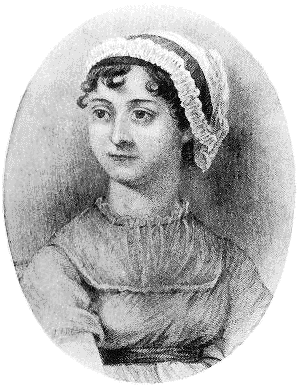
Celebrating the 200th anniversary of the first published copy of Pride and Prejudice by Jane Austen, the BBC is putting on an authentic recreation of a Regency ball, titled Netherfield Ball. It is to be filed on location at Chawton, Hampshire, where Austen spent the last eight years of her life.
According to The Independent, "in the 90-minute [BBC] special, Pride and Prejudice: Having A Ball at Easter, experts will re-stage the planning and rehearsals for an early 19th century ball, as well as [look] back at the first-hand testimony of ball-goers of the time."
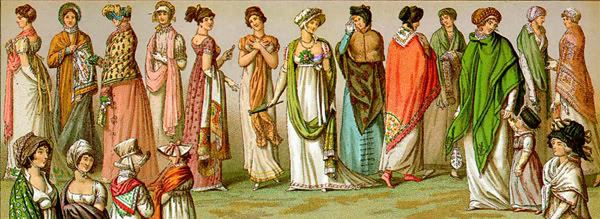
The program will look at all aspects of the food, beverages, costumes, dances, music, furnishings, and decorations. Experts—such as food historian Ivan Day, literary expert Professor John Mullan, author Amanda Vickery, curator and expert on the history of dress Hilary Davidson, and Stuart Marsden and Dr. Anne Daye who will choreograph the dancing—will ensure that all the details are authentic to the time period, place, and Austen's work. The program will also explore the social history of Austen's world.
Note, this ball is not open to public, even at exhorbitant fees, so I wonder who's going to get chosen (and how) to participate in the filming.
Would you be interested in participating in such a ball, or do you prefer to watch it on your television?
Write back:
0
comments
Posted on:
1/23/2013 11:06:00 AM
Labels: Research: Books, Research: Costumes, Research: Culinary, Research: Customs, Research: FineArts, Research: LiteraturePoetry, Research: Regency
Copyright 2006–2023 Keira Soleore (keirasoleore.blogspot.com)
Jane Austen was born in 1775 at the old Steventon Rectory in the Hampshire countryside and lived there for nearly 25 years. She wrote Pride and Prejudice and Sense and Sensibility there. After her family moved to Bath, the rectory was soon demolished and the land became a pasture over the years.
A recent archeological dig at the site has unearthed foundations and objects and revealed secrets of Austen's early home life.
"Contemporary records and an initial geophysical scan of the ground was used to identify the exact position of the house. No visible signs of the building remained, aside from a blocked-off well. Project director Debbie Charlton, of Archeo Briton, said: 'It was nerve wracking when the first bricks appeared. We weren't 100% sure we were in the right place when we started.'"
The revealed foundations match the description of the house published by Austen's nephew. Even then, he knew that Austen was going to be popular and fans would be seeking all such details about her.
The scientists unearthed nearly 500 shards of china, storage jars, wine glass stems, and clay pipes and 1,000 nails. Plate shards reveal the famous blue willow pattern that the family would've eaten off of. "The initial studies of the finds of pottery and storage utensils have revealed a more down-to-earth existence of the family" than depicted in Austen's books.
Scientists hope that "the finds will go on display at Basingstoke's Willis Museum when a full study has been completed."
Write back:
0
comments
Posted on:
1/21/2013 06:51:00 AM
Labels: Research: Archeology, Research: Architecture
Copyright 2006–2023 Keira Soleore (keirasoleore.blogspot.com)
Pottery from the Indus Valley Civilization at the Mohenjodaro Museum in the Larkano district of Sindh, Pakistan.
The Indus Valley Civilization was a Bronze Age civilization (3300–1300 BCE) located in the northwestern India and Pakistan. It is one of the world's earliest urban civilizations, along with its contemporaries, Mesopotamia and Ancient Egypt. However, at nearly 487,000 square miles, the Indus Valley is the largest ancient civilization.
Carnelian handicrafts, carved seals, daily items made from copper, bronze, lead, and tin, and so on have been discovered during the excavations of Mohenjodaro and Harappa among other Indus Valley Civilization sites. One of the hallmarks of the civilization are the civic structures: cities built of brick, public baths, roadside drainage systems, and multi-storied houses.

[Image copyrighted by the Mohenjodaro Museum.]
Write back:
0
comments
Posted on:
1/18/2013 08:06:00 AM
Labels: Research: Archeology, Research: Asia, Research: Crafts
Copyright 2006–2023 Keira Soleore (keirasoleore.blogspot.com)
As a new shiny year begins, my thoughts turn naturally to the books I will be reading this year. So I visit author websites of my auto-buy authors, listen to Twitter buzz on what people are reading, look through Amazon and trusted people's recommendations to try to read outside my comfort zone, be it, a different sub-genre of romance novels or something entirely different. Here are a sampling of the books I'm anticipating reading this year.
January
"That Scandalous Summer" by Meredith Duran
"His Very Own Girl" by Carrie Lofty
February
"The Good Daughter" by Jane Porter
"Crystal Cove" by Lisa Kleypas
"Crazy Thing Called Love" by Molly O’Keefe
"The Autumn Bride" by Anne Gracie
"The Conquest of Lady Cassandra" by Madeleine Hunter
"What Happens in Scotland" by Jennifer McQuiston (debut rec by PJ)
"Conor's Way" by Laura Lee Guhrke (rec by Wendy the Super Librarian)
March
"As You Wish" by Eloisa James
"What Darkness Brings" by C.S. Harris
"The Foundling" by Georgette Heyer
"Simon the Coldheart" by Georgette Heyer
April
"Love Irresistibly" by Julie James
"The Bridgertons: Happily Ever After (2nd Epilogues)" by Julia Quinn
"One Texas Night" by Jodi Thomas
"Vienna Waltz" by Teresa Grant (rec by Isobel Carr / Kalen Hughes)
May
"Once Upon a Tower" by Eloisa James
"It Had to Be You" by Jill Shalvis
"The Dragon's Bride" by Jo Beverley
"The Duke's Wager" by Edith Layton (rec by Miranda Neville)
June
"The Sum of All Kisses" by Julia Quinn
"Can’t Stop Believing" by Jodi Thomas
"Vixen in Velvet" by Loretta Chase
"A Woman Entangled" by Cecilia Grant
"The Duchess Hunt" by Jennifer Haymore
September
"The Burning Sky" (Elemental Trilogy) by Sherry Thomas
"An Ideal Scoundrel" by Miranda Neville
"Redeeming Love" by Francine Rivers (inspy rec by Darlene Marshall)
"Sunshine and Shadow" by Sharon and Tom Curtis (Amish inspy rec by Joanna Bourne)
November
Book by Jane Porter
Write back:
0
comments
Posted on:
1/16/2013 07:50:00 AM
Labels: Leisure: Reading
Copyright 2006–2023 Keira Soleore (keirasoleore.blogspot.com)
The London Underground or The Tube recently celebrated 150 years of existence as an underground metropolitan transportion system.
The sight of a chuffing steam locomotive engine emerging from the underground tunnel led to cheers and rapid snapping of photographs recently as people rode the passenger carriages and spectators watched history in action. The journey from Kensington Olympia station in west London of Met Locomotive No. 1 commemorated the 1898 historic trip, according to the BBC. Original look-alike burgundy and gold tickets were issued to a few lucky passengers.
"Chugging along at a speed of 25mph—modern day Tube trains can reach 50mph—it headed through central London via the Circle line; taking in stations including Edgware Road, Baker Street, King's Cross and the Barbican before arriving into Moorgate."
The person who had the daunting task of ensuring there was enough steam to drive the train was Oliver Furnell from the Forest of Dean.
The fireman, who ordinarily drives trains through heritage lines in the countryside, said there was no real difference in how to drive it, but the "environment that it's happening in, that's the unusual bit".
Fireman Oliver Furnell from the Forest of Dean was tasked with making sure there was adequate steam to make it around the journey and especially up Notting Hill. "It's quite surreal to be rolling through a modern Tube station and people seem to be pleased that you're there," he said wryly.
Write back:
0
comments
Posted on:
1/15/2013 09:01:00 AM
Labels: Research: Transportation, Research: Victorian
Copyright 2006–2023 Keira Soleore (keirasoleore.blogspot.com)